

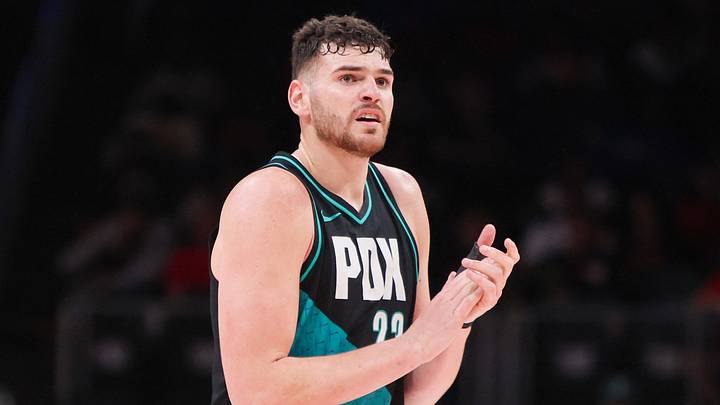
Donovan Clingan has solidified his place as a building block in Portland after a second-year breakout. He's arguably become the second-most important piece on this entire roster behind All-Star Deni Avdija, especially when you consider how important his presence as a defensive anchor is to the Blazers' defensive identity.
Everything has gone according to plan as far as how he's been able to impact winning on the defensive end, as Clingan is already in the conversation amongst the league's best rebounders and rim protectors.
Offensively, the Blazers always had confidence in his potential to space the floor, but this past season we actually caught a glimpse of what that floor-spacing version of Clingan looks like. He's only getting better on that end, which gives Clingan a higher ceiling than most expected as a prospect out of UConn.
Clingan has already made Portland's No. 7 overall selection both one of the best of that 2024 draft class and, most importantly, the best of their entire rebuild. Look at how they felt the need to address the backcourt uncertainty by bringing in Morant, which signals their lack of confidence in Scoot Henderson and Shaedon Sharpe being the long-term answer there.
Blazers bolster frontcourt depth amid Yang Hansen uncertainty
The Blazers may have a similar logjam in the frontcourt, but that's more about the uncertainty after Clingan than anything about him starting. They had to bring in Branden Carlson, Micah Potter, and Jeremy Sochan to compete for frontcourt depth because even Robert Williams III and Yang Hansen weren't enough.
That's the premium they continue to pay in the Hansen draft gamble, as Portland is essentially down a roster spot every season until he can contribute. They are healthier and deeper now, which at least allows them to slowly bring Hansen along. But again, what is Portland bringing him along for? To become a really good backup?
Hansen is getting better, but the gap between him and Clingan remains a galaxy away. Portland has a legitimate above-average starting center on its hands for the next decade plus thanks to their Clingan selection. Neither can play the power forward position, which is a developmental roadblock in terms of available minutes they can eventually grow into.
So Portland does have a plan in place to avoid relying on Hansen in the short term. But eventually, one has to wonder whether it's even worth going through this much of a roster inconvenience?
Hansen looked better in this year's Summer League but still needs to prove he can translate any of that success to the NBA level. That's difficult with the two-timeline approach for Portland, a team taking on a multi-year project at a position they already have solidified while trying to build off a postseason appearance.
Even when he's not playing, Hansen remains a key point in roster construction and decision-making. At what point does Portland pull the plug on this experiment? And if not, how much does it continue to negatively impact their roster going forward?
Blazers already have their center of the future in Donovan Clingan
There are upsides to continuing to invest in his rare skillset as a seven-footer and the tantalizing ceiling that comes from it if he can ever become an offensive hub in Portland. That still has a long way to go in becoming reality, as it would mean not only beating out Clingan but also becoming good enough to run the offense through.
That's still the best-case-scenario outcome of how Portland envisions using Hansen's skill set, only the inability to translate that to the NBA level is raising questions about how that game scales in a lesser role, if at all.
The opportunity cost of the initial Hansen draft gamble was Cedric Coward, or whoever Portland actually would've taken themselves with the No. 11 overall pick had they stood pat.
But entering this season, there's the opportunity cost of Portland having a frontcourt logjam to cover for Hansen (and Williams' injury-proneness) when they should be adding more wing and forward depth behind Deni Avdija and Toumani Camara. Right now, they're looking at Vit Krejci, who struggled in his Blazers season debut, and Sidy Cissoko, who can't space the floor and still has overall growing pains at 22 years old.
That's what makes the Hansaen gamble increasingly difficult to justify, as this is a roster burden that the Blazers deal with every summer until he's finally good enough or they finally cut ties. It would be one thing if Portland were still a patient rebuilding team or still needed its center position figured out, but Clingan turned out to be one of the best assets from this entire rebuild. It's more difficult for the Hansen pick to return value because of the diminished returns from investing consecutive first-round picks at the center position.
For a team relying on Clingan to get them back into the postseason with only a few years remaining on Lillard's window, at least they have the frontcourt depth as a strength heading into the 2026-27 season. Where we go from there as far as Hansen's growth, continued investment, and decreasing chance of justifying this first-round gamble after coming away with Clingan the year prior, that's another question entirely.
 Add us as a preferred source on Google