

Wings are as important as ever in the modern NBA. It's tied hand in hand with the league becoming increasingly matchup-oriented. Versatility and switchability are crucial in a league where teams are constantly hunting to get their stars the ideal mismatch.
Offensively, we're now in the era where the offensive initiators are those wings/forawrds with skillsets similar to that of a jumbo wing. Players like Luka Doncic, LeBron James, Cade Cunningham, and now even Deni Avdija are able to capitalize on that mismatch, creating opportunities for both themselves and others as they break down the defense.
It takes a special talent to become such a matchup nightmare with the rare combination of physical tools, ballhandling, and court vision, among others. So if Portland finally has one of these matchup nightmares of its own in Avdija, why do they still feel so far behind in the modern NBA?
To their credit, the Blazers had a strong shot profile last season, which is something Micah Nori pointed out at his introductory press conference. Portland even attempted the third most three-pointers per game under Tiago Splitter, behind only the Golden State Warriors and Charlotte Hornets.
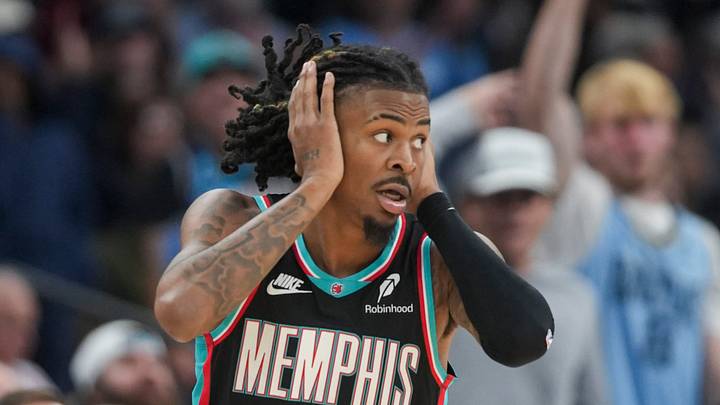
So they do have a few aspects of the modern NBA down, but even that stark difference between their three-point attempts and efficiency shows that this roster needs to catch up to Portland's playstyle. Now they bring in another non-floor spacer into the equation in Morant, coming off a career-worst 23.5 percent three-point shooting season.
Blazers crowd their backcourt in search of a long-term answer
There are serious question marks regarding the fit of this roster, both positionally and from a skillset redundancy standpoint. It's hard to see where Morant fits defensively with Damian Lillard, or offensively with Avdija as two of the most downhill-dependent players in the association.
That uncertainty has resulted in a backcourt logjam in Portland, one that has more questions than answers entering a season where they appear content to wait to resolve anything. That will give them more time to evaluate the logjam before deciding on the future of players like Shaeadon Sharpe and Scoot Henderson, though the latter is currently eligible for a rookie-scale extension.
So now you have a situation with four point guards because you essentially don't feel entirely comfortable with any one of them going forward.
Portland took a low-risk bet that Morant could return to pre-injury form and look closer to the two-time All-Star he was in Memphis. They also don't fully know what they have in Lillard this season and whether he'll return to form coming back from the Achilles tear. Then there's Holiday, who isn't getting bought out by the Blazers but could be considered a trade candidate as the season progresses.
All this because Henderson didn't live up to his lofty No. 3 overall draft expectations.
Portland added more Yang Hansen insurance this summer
Portland has a similar predicament in their frontcourt logjam as they have to add depth because their first-round Yang Hansen gamble has not paid off to this point.
Extending Robert Williams III was a good move regardless thanks to the injury protections included in his three-year, $44 million deal. They also brought in former Thunder big man Branden Carlson. He realistically could enter the season already ahead of Hansen on the depth chart.
Portland still needs to figure out its frontcourt rotation and finalize its 15-man roster, as they have non-guaranteed deals like Micah Potter and Jeremy Sochan. But the point remains: they needed depth behind the injury-prone Williams, and Hansen wasn't reliable enough to provide that on a win-now team.
These decisions to search for the long-term guard solutions with as many options as possible and continue investing in a multi-year project in Hansen are all beneficial to Portland's long-term outlook. These are holes or questions in their rebuild that needed to be addressed to help with decision-making going forward.
In the process, however, the Blazers have wound up with a team full of point guards and centers in a league where wings hold the most value.
Blazers are heading into 2026-27 hurting for valuable wing depth
Some of that is a testament to Deni Avdija and Toumani Camara. Portland already knows it has two building blocks, so doesn't necessarily need to hold auditions or whatever it is they currently have going on in the backcourt.
But after seeing Jerami Grant, Kris Murray, and Matisse Thybulle all take their two-way talents elsewhere this summer, you can't help but wonder if Portland knows how bad it's hurting for depth. Sidy Cissoko can only do so much, ya know?
Up and down the roster, the Blazers have above-average depth, but how does that translate when a lot of that is coming at the same positions?
The modern NBA has also embraced this concept of positionless basketball. That doesn't mean you can suddenly start Morant and Lillard in the backcourt together and still not have defensive limitations likely to be a roadblock in the postseason. If anything, that is more about the concept of versatile wing players like James, Avdija, etc. who can play multiple positions.
Without wing depth, Portland isn't even fully capitalizing on Avdija and Camara's versatility. They're more limited to the three and four positions, because Portland has an excess everywhere else.
Hopefully this is just a short-term mess that Portland needs to sort out, and they continue to find better roster balance going forward. At least they have a good foundation from winning their trades to land Avdija and Camara.
But the next step in adjusting to the modern NBA is to continue adding versatile wing depth behind them. It's one of the most valuable aspects of roster construction, and seems to have been an afterthought based on Portland's offseason moves.
 Add us as a preferred source on Google