

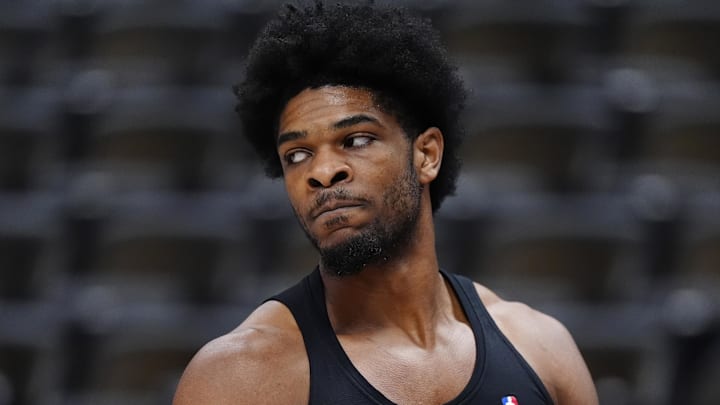
Scoot Henderson was once viewed as a consolation prize for missing out on the Victor Wembanyama sweepstakes. In 2023, the Portland Trail Blazers missed out on a generational prospect in Wembanyama by one lottery ball combination. At the time, the silver lining to Portland selecting at No. 3 was that they were still in that second tier of prospects, Henderson and Brandon Miller. That made Portland's decision-making easy, as they drafted whoever remained.
Well, fast forward to 2026, and it's already become apparent that Henderson was not the right pick for Portland. He's not quite the bust some have made him out to be, but he's also failed to meet those lofty draft expectations.
Barring a drastic improvement in playmaking and shooting, the Blazers whiffed on this franchise-altering pick. The NBA is a copycat league, and everyone needs to be learning from Portland's Henderson draft mistake.
Teams should learn from Portland's Scoot Henderson miss
Draft misses happen all the time, but there's a lesson that can be taken away from this Henderson selection in particular.
First, it shows that teams shouldn't be locked into a consensus of prospects; they should strongly consider options outside the conventional tiers. There's another tier of top three prospects forming this year between Cameron Boozer, Darryn Peterson, and AJ Dybantsa, but teams really should be considering all their options.
One reason Henderson's transition to the NBA hasn't been as smooth as expected is that he's no longer the elite athlete he once was relative to the competition. He stood out on the G League Ignite as a top-tier athlete, which allowed him to play to his strengths as a guard who can get downhill at will, opening up the rest of his game.
That hasn't been the case in the NBA, where Henderson is a good, but not a standout, athlete. He's no longer getting away with the same things, finding difficulty in his playmaking and ability to create separation. That's exposed weaknesses such as his turnovers and shooting, as he can no longer rely on those strengths to mask them.
Boozer, Peterson, and Dybantsa all have something to prove
There are flaws to nitpick among all the top options, whether it's Boozer's lack of explosiveness, Peterson's durability and motor concerns, or Dybantsa's shot selection.
To return value on these top draft pick investments, prospects either need extreme strengths or a well-rounded enough game. Henderson's athleticism didn't live up to the top-tier hype, and he turned out to be another average player. What Boozer, Peterson, or Dybantsa do well, they need to do really well. Alternatively, they need to have a strong enough, well-rounded game so that they aren't overly reliant on one trait. There are so many college bigs who relied on their size, becoming just another player when they reached the next level.
Dybantsa gives us some Andrew Wiggins vibes as a special athlete coming out of Kansas, only to be a solid, but not elite player in the NBA because he's suddenly in a league of 1% athletes. Boozer will have to embrace his perimeter game and find other ways to be effective, as his bully-ball style won't work against bigger players. Peterson will have to prove he can play the entire regular season in a more physical, competitive NBA.
What looks black-and-white for these prospects now won't be in the NBA. That was even more the case with Henderson, who was coming out of the G League rather than playing college, where he would've had a much different evaluation process. Henderson's strengths as an elite athlete didn't translate, lowering his ceiling. And his weaknesses were suddenly exposed, lowering his floor to becoming a bench player in Portland.
It's easy to say in retrospect, but if Portland had looked beyond the conventional tiers and taken the player whose strengths would translate more clearly to the NBA, Amen Thompson would be in a Blazers jersey right now.
 Add us as a preferred source on Google