

Kris Murray's minutes have trended downward this season for the Portland Trail Blazers. In March, Portland's former first-round selection is averaging 15.4 minutes per game. That's a noticeable decline for someone who's averaging 23.4 minutes per game on the season and has even started in 15 games.
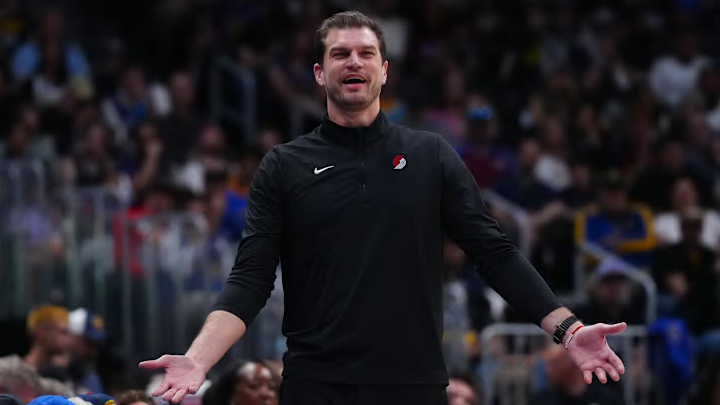
Murray was previously seeing a large role out of necessity, as head coach Tiago Splitter had few other options. But now the Blazers are getting healthier at the right time as they look to make a playoff push out west, which has caused Murray to take a back seat as Splitter finally has more reliable options at his disposal.
Kris Murray's minutes decline as shooting woes persist
As good as Murray is on the defensive end, he's even worse on the offensive end. The value he provides defensively as a 6-foot-8 forward capable of guarding multiple positions is far outweighed by his lack of shooting.
Murray was viewed to be one of the more NBA-ready prospects after spending three productive seasons at the University of Iowa. But unfortunately, that collegiate success hasn't translated to the next level, largely because he's an offensive liability who can't effectively space the floor.
It's hard to carve out a long and successful NBA career if you aren't a shooting threat, particularly as a wing in the modern NBA. That issue has been compounded by Murray's landing spot, as the Iowa product and the Blazers are a questionable fit for each other.
Murray could benefit from a change of scenery, joining a team that can better mask his offensive limitations and let him play to his strengths. He's not going to get that in Portland, trying to fit into a roster that has consistently ranked near the bottom of the league in three-point efficiency. Splitter can no longer rely on Murray for extended stretches, as shooting quickly goes from weakness to fatal flaw with him out there.
Blazers should prioritize Sidy Cissoko over Kris Murray
He also faces increased competition with the emergence of Sidy Cissoko, whom the Blazers converted from a two-way contract to a standard one. Cissoko has floor-spacing issues of his own, and their strengths and weaknesses overlap too much for Splitter to have them share the court, further cutting into Murray's minutes.
After bringing Cissoko into the picture, it suddenly becomes unclear how Murray fits into Portland's long-term plans. At least with Cissoko, the shooting is trending in the right direction for a player who is also four years younger.
You never want to prematurely give up on a first-round pick who has only spent three years in the league. But at the same time, the poor fit and lack of progress make it hard to justify a continued investment.
Murray shot 26.8% from three-point land as a rookie, and he's shooting 26.5% this season. This is a player who has seemingly plateaued as a shooter, which is concerning given the gap he needs to overcome to become a viable option in Splitter's rotation.
Three years later, with little progress to show, it's safe to say Portland missed on this pick.
 Add us as a preferred source on Google