

The Portland Trail Blazers' season was an overall success, finishing 42-40 and returning to the postseason for the first time since 2021. That doesn't mean there weren't growing pains along the way for this up-and-coming roster.
Portland overcame early adversity with the loss of a head coach, injuries, and one of the hardest schedules in the league. They found their rhythm towards the end of the season, peaking at the right time to come out of the Play-In Tournament in a stacked Western Conference.
Growing pains and overcoming adversity were the two best ways to describe this season, and it's reflected in the grades for each player.
Trail Blazers 2025-26 Season Report Card
Deni Avdija: A
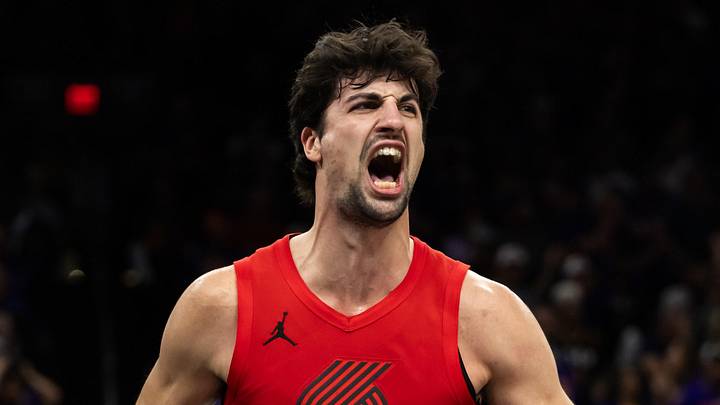
Avdija's All-Star ascension was the best thing to happen in Portland's entire season. This year officially made the Blazers the winners of their trade with the Wizards, proving they stole a rising star.
Avdija had a career year, averaging 24.2 points, 6.9 rebounds, and 6.7 assists as he took on more of a point-forward role in Portland's offense. He single-handedly kept their season afloat amid injuries, filling whatever void was necessary thanks to his well-rounded game.
A lingering back injury prevented this grade from being an A+, as Avdija started to slow down post-All-Star break. But that's nitpicking, as Avdija exceeded expectations in every facet, becoming Portland's new franchise cornerstone in the process.
Toumani Camara: B-
Camara's defense took a small step back from his All-Defense campaign the year prior. He was still one of Portland's most impactful players, given his coveted 3-and-D archetype.
The counting stats of 13.4 points and 5.1 rebounds don't do justice to Camara's impact. But perhaps the most underrated aspect is his availability. Camara is a true workhorse for Portland, appearing in all 82 games while averaging 33.3 minutes and guarding the opposing team's best player on a nightly basis.
He didn't show much progress in terms of his playmaking or shot creation on the offensive end, preventing this grade from being higher. But that's fine, as the current version of Camara is still valuable enough to be considered a legitimate building block in Portland.
Sidy Cissoko: C+
Cissoko was a pleasant surprise for Portland. He played a bigger role than expected this season, including 26 starts. That ultimately was enough for the Blazers front office to continue their investment in Cissoko, converting him from a two-way contract to a standard one.
That was the right decision given his flashes of two-way upside. But Cissoko still needs to grow on the offensive end to become anything more than an end-of-the-bench player, particularly when it comes to his streaky shot.
While the offensive concerns are valid, the fact that he secured a more permanent spot on this roster has to be considered a relatively successful season.
Donovan Clingan: A-
Clingan was arguably the second-best player this season, behind Avdija. Portland doubled down on its defensive identity this past summer, and part of that was the decision to buy out Deandre Ayton to clear the path for their rim protector.
Clingan's presence as a defensive anchor has even surpassed Camara's impact, becoming the true defensive identity of this team. He's already put himself firmly in the conversation as a top-five rim protector who continues to expand his offensive arsenal.
The most significant development came from his three-point shot, where the 7-foot-2 big man shot a respectable 34.1 percent from deep on 3.2 attempts per game.
A few things prevent this from being a perfect grade: the foul trouble, poor perimeter defense, and post-game still have room for improvement. That said, this was an encouraging season for Clingan, proving he's the starting center of the future and worthy of being built around.
Jerami Grant: B-
Grant had a relative bounce-back season, averaging 18.6 points on improved efficiency. Portland was wise to bring him off the bench, where he provided much-needed scoring and shot creation for a defensive-minded second unit.
It's difficult to differentiate the grade from the poor rebuilding fit here, given his age and contract. But in terms of what their roster needed this particular season, Portland benefited from having Grant out on the court. His shooting in particular lifted the Blazers' offense in times of need.
Hopefully, this resurgence is enough to boost his trade value for Portland to finally shed his massive contract this summer.
Yang Hansen: D
Unfortunately, Hansen was absolutely unplayable and looked lost on the court more often than not. Tiago Splitter understandably didn't want to throw their rookie into the fire, but it was disappointing for fans eager to see the rookie in action after a promising Summer League.
Hansen's performance in the Summer League and G League prevents this from being an F, but this season didn't bring any more clarity to what was a controversial draft selection at the time. It's apparent the Blazers have a multi-year project on their hands, so hopefully he shows progress next season.
Scoot Henderson: C+
Scoot's up-and-down season that was shortened by a hamstring injury is the most difficult to grade. Overall, we enter the offseason slightly more optimistic about his long-term outlook compared to last summer, which has to mean he's trending in the right direction and worthy of an above-average grade.
There were legitimate flashes of him improving, particularly as an off-ball 3-and-D weapon for Portland. That was on full display in their playoff series against the Spurs, at least at the beginning. The second half was more of the same old Henderson, struggling with his playmaking and finishing.
If you look at it through the lens of a former No. 3 overall pick, this wasn't the season you would've hoped for. If you redefine expectations and compare this version of Scoot to the one who entered the league, you can see the maturity and signs of growth. At this point, that's all Portland can ask for.
Jrue Holiday: B
Holiday was exactly as advertised. He even had a bit of a bounce-back season after his numbers decreased in his final season in Boston. Holiday dealt with injuries again this season, but this Blazers version embraced more of a playmaking role, filling in the void of their depleted backcourt.
He's had one of the most underrated careers as a two-way guard who simply elevates the floor and ceiling of everywhere he goes. That was more of the case in Portland, as it wasn't a coincidence they returned to the postseason in Holiday's first year.
From a win-now standpoint and a veteran leadership standpoint, the Blazers are getting the exact short- and long-term benefits they had hoped for when they traded for Holiday yet again.
Vit Krejci: D
Portland made a move on the margins at the deadline, acquiring sharpshooter Vit Krejci from the Atlanta Hawks. That was general manager Joe Cronin's band-aid solution to somewhat address their shooting woes without sacrificing any assets of significance.
The problem with that plan, however, was that Krejci was an entirely different player since coming to the Pacific Northwest.
This was someone who exceeded 40 percent from three for three consecutive seasons in Atlanta, only to see his efficiency dip to 30.3 percent in Portland. It was a limited sample size of 19 games, making it difficult for Krejci to find his rhythm in a new environment.
Hopefully, he returns to form and gets more comfortable with an entire offseason under his belt. We liked the low-risk trade at the time, but Krejci needs to become that knockdown shooter again in order to see minutes and for the deal to return value for Portland.
Kris Murray: C
Murray was servicable in his third season, which was quietly the best of his career. He's frustrating to watch at times due to his limitations on the offensive end as someone who shrinks the floor.
Ideally, Murray would show some more progress in the shooting department. But to his credit, he has embraced being a role player who impacts winning without requiring the ball.
He's someone who does the inganbiles, snags rebounds, and is a versatile wing defender. That's valuable on any team. It's not as great a fit in Portland, where shooting is already a liability up and down the roster.
Shaedon Sharpe: B
Statistically, Sharpe had the best season of his promising young career, finishing with 20.8 points, 4.3 rebounds, and 2.6 assists. That's enough of a leap to justify Portland's contract extension prior to the season, as he showcased the progress and upside worth investing in.
But the same questions have lingered throughout Sharpe's entire career up until this point. The lack of a two-way impact is the most concerning aspect of his development. For someone with elite physical tools, he doesn't apply himself well enough on that end of the court.
Offensively, the shot selection, shaky three-point shooting, and a 2.6-to-2.9 assist-to-turnover ratio are all legitimate causes for concern. Sharpe continues to grow into his strengths as an athletic, score-first guard. But until he addresses those weaknesses, his value won't be anything more than a sixth man on a contender.
Matisse Thybulle: C-
The perimeter defense remains elite for Thybulle, giving Portland underrated depth and yet another individual defensive weapon. The issue here is availability. Portland's 3-and-D veteran wing has totaled just 45 games played the last two seasons, including 30 this year.
Thybulle is set to hit free agency, and Portland has to factor his injury proneness into its decision of whether to bring him back next season. This year has been more of the same, underwhelming yet enough stretches of elite defense to give them at least some reason for consideration, especially when that's their team's calling card.
Blake Wesley: C-
Wesley was a pleasant surprise at the beginning of the season, quickly becoming a fan favorite as he saw an increased role in Henderson's extended absence. Unfortunately, that momentum was derailed when he suffered a foot fracture. Wesley struggled to carve out a role when he returned to a healthier Blazers backcourt, largely due to his offensive limitations.
This is another one Portland will have to consider regarding free agency. He fit their defensive identity, but can they really afford to roster all these non-shooters?
Robert Williams III: A-
Time Lord was one of the best storylines of the season for Portland. He played 59 games, which was the second most in his career. He was exactly what the Blazers needed in the frontcourt this season, providing them with versatility, a lob threat, and another defensive anchor. Williams even outplayed starting center Clingan in their playoff series with the Spurs, as he was better equipped for their style of play, given his ability to defend out on the perimeter.
The fact that Williams played this many games already makes the season a success. But he was legitimately impactful when available, looking like the Celtics version of the player Portland traded for.
Another soon-to-be free agent, Williams made the most compelling case to stick around in Rip City. This season proved he's become an essential piece of their frontcourt.
 Add us as a preferred source on Google