

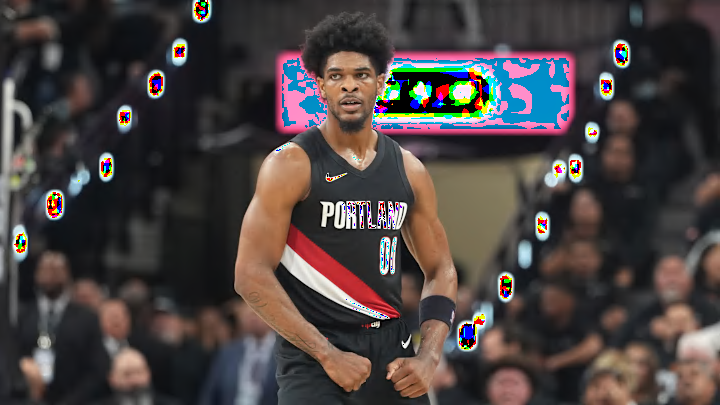
At his end-of-season exit interview, Scoot Henderson said his focus this summer will be improving his shot and finishing ability. Those have been two of Henderson's most glaring weaknesses since entering the league.
Some prematurely declared Portland's No. 3 overall pick a draft bust as he struggled in multiple aspects as a rookie, including shooting, finishing, turnovers, and defensive awareness. A lot of that had to do with his overall decision-making. Scoot was overly eager to prove himself in the league, which negatively affected his play as he tried to force the issue far too often.
His development has been a prime example of why we must remain patient with young guards entering the league, considering the point guard is the most difficult position to adjust to at the next level.
Henderson just finished his third season, which was largely derailed by an untimely hamstring tear suffered during an offseason workout. That limited 30-game stretch he was available, however, was the best of his promising young career.
Scoot Henderson's summer focus could unlock Portland's offense
Henderson averaged a career high 14.2 points per game, along with 3.7 assists and 2.7 rebounds while shooting 41.8 percent from the field and 35.2 percent from beyond the arc. Most impressively, this was in what was arguably his least significant role since entering the league.
Henderson averaged a career low 24.9 minutes per game, starting in just ten contests. His 24.9 percent usage rate ranked third on the team, behind Shaedon Sharpe (30.5) and Deni Avdija (29.1). It's an understandable progression: Scoot fell down the offensive hierarchy as the team got better and ended its playoff drought.
But Henderson also deserves credit for adjusting well to the diminished, and often inconsistent, role. This was no longer the rookie Scoot who had a few historically bad plus-minus games; it was someone who actually contributed to winning basketball with his two-way impact. Jrue Holiday's arrival certainly helped accelerate that growth, particularly on the defensive end.
"I think when Scoot got comfortable, you saw what he's capable of, and that's the tip of the iceberg," Holiday said at his exit interview. "Him getting a full season of being healthy ... I think he has a bright future."
At the same time, it was simply a matter of Scoot becoming a more mature player. At 22, he's finally learned how to shift gears, doing a much better job of knowing when to attack rather than taking his reckless, all-gas, no-brakes approach. That shift in decision-making has been the biggest improvement since entering the league, and we've seen it on both sides of the ball.
With Scoot making the right reads more frequently, it now comes down to execution -- making shots and finishing drives.
Henderson has quietly become a valuable 3-and-D role player for Portland as he's embraced a more off-ball role. That will help his fit with Damian Lillard's return next season as well. Still, Portland desperately needs more reliable floor spacing from its up-and-coming backcourt. If Henderson can become a more consistent offensive threat, it's going to do wonders for opening up the entire offense.
We saw some flashes of what that could look like in their playoff series against the Spurs. Now it's a matter of putting those games together more consistently.
 Add us as a preferred source on Google