

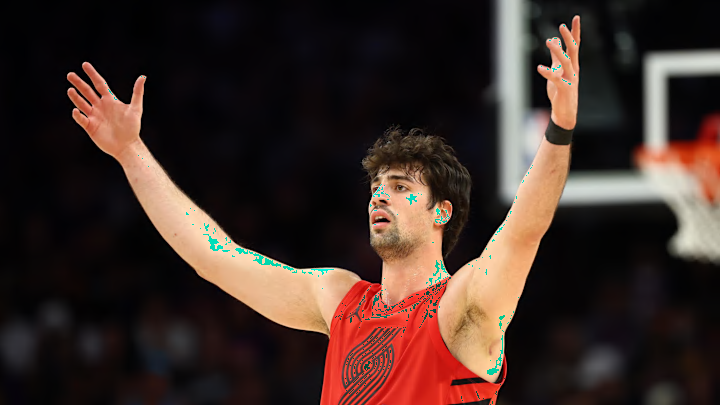
The Portland Trail Blazers ended a four-year playoff drought this season, but their shooting woes exposed how far they still are from being considered genuine contenders.
Shooting has been an Achilles heel for Portland throughout this entire rebuild. Unsurprisingly, it was the biggest contributing factor behind an early playoff exit in what turned out to be a five-game series against the San Antonio Spurs.
The Blazers ranked third-worst in three-point efficiency in both the regular season and playoffs this year, shooting 34.3 percent and 30.2 percent, respectively. That unreliable floor spacing was essentially the difference-maker in the series, considering San Antonio currently leads the playoffs at 41.8 percent.
Shooting continues to plague the Blazers' rebuild
Portland actually deserves credit for making this a much more competitive series than the final 4-1 result indicated. They put themselves in position to take a commanding 3-1 lead, stealing Game 2 on the road while leading in both subsequent home games.
Unfortunately, that wasn't the outcome, largely because their offense stalled. Portland wasn't able to generate enough offense to maintain the lead in either match, resulting in consecutive second-half collapses.
Blazers fans know the story, as this offense has been wildly inconsistent throughout the season. Still, it's encouraging that they managed to finish 42-40 and secure a seventh seed despite this glaring shooting flaw. If Portland can even become an average shooting team, they have a legitimate shot at a deep playoff run.
To some extent, they were hoping that their trade deadline acquisition of Vit Krejci would be at least the start of a solution. That looked like a wise move on the margins at the time, but Krejci surprisingly fell out of Tiago Splitter's rotation despite their glaring need for floor spacing. He averaged just 4.0 minutes per game in the San Antonio series, with the majority of that coming when Splitter was desperately pushing buttons to find the right combination in their elimination game.
The biggest flaw in Portland's young core
This series proved that Portland's shooting woes go far beyond a move on the margins. In fact, it's not even something that Damian Lillard's return will fix entirely. The Blazers have a serious issue with how their young core is currently constructed, as Scoot Henderson, Shaedon Sharpe, Toumani Camara, Deni Avdija, and Donovan Clingan are all poor-to-average three-point shooters. Henderson got hot at the beginning of the series, temporarily mitigating that issue, but it ultimately wasn't a sustainable solution.
Portland needs to consider mixing up its young core as soon as this summer, as these playoffs have provided some clarity that they can't continue to stay the course.
It remains to be seen who will become available as a trade piece this summer. New Orleans Pelicans wing Trey Murphy III was someone we pushed for at the deadline. But if it's not Murphy, it needs to be a Murphy-adjacent player. Someone whose age fits into the timeline of the Blazers' young core, doesn't compromise their defensive identity, but addresses their shooting concern in a major way.
That ideal shooting piece will be challenging to find, but it's the essential next step for Portland to take if they want to become a true contender. Fortunately, they have a stockpile of young assets and draft capital to make it happen.
 Add us as a preferred source on Google