

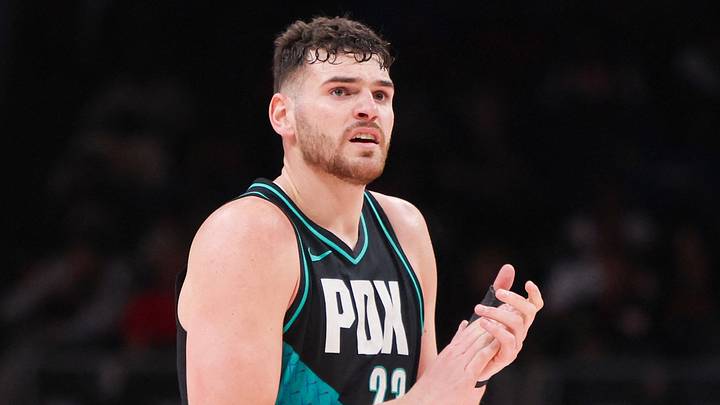
Through preseason, the Portland Trail Blazers' unique roster seems like it's only an advantage against certain teams and a weakness against others. That primarily has to do with the way their defense is set up, anchored by the drop coverage of 7-foot-2 center Donovan Clingan.
Between Clingan and backup center Robert Williams III, head coach Micah Nori has the luxury of having rim protection out there at all times. It makes Williams' three-year, $44 million extension look even better considering he's somehow now become even more important as a backup big in Portland.
There was much concern surrounding how the undersized guards and backcourt logjam would compromise the Blazers' defensive identity. Though they may have taken a step back in that regard this summer, it could ultimately be in this team's best interest in hopes of finding a better roster balance. They desperately needed more ball handlers and playmaking as a team that ranked first in turnovers last season.
The Blazers' offense was entirely too stagnant last season and overrelied on their new All-Star, Deni Avdija. We saw that contribute to their quick first-round playoff exit at the hands of the San Antonio Spurs. Preseason is a small sample size, with the Blazers 3-1 finish capped off by Friday's 128-118 road loss to the Golden State Warriors. Still, early indications are promising that this revamped backcourt should result in a drastic offensive upgrade.
This guard-heavy formula never would've been as effective had it not been for the paint presence and rim protection of Clingan and Williams. That said, it does leave Portland somewhat exposed to certain matchups, particularly when teams have a stretch five or mobile big that can take advantage of Clingan's drop coverage.
Donovan Clingan's drop coverage makes the Blazers too matchup-dependent
Williams is an upgrade in that sense, as he's better equipped to defend out on the perimeter as the more versatile big between the two. Still, the Blazers need these elite rim protectors in the paint, maintaining that sense of defensive identity to cover for all their guards.
Last year, teams playing against the Blazers constantly talked about how much Portland's length bothered them. That won't be their formula for success this season. It suddenly leaves them vulnerable to teams with certain roster constructions.
For instance, Atlanta Hawks big man Onyeka Okongwu gave Clingan tremendous matchup problems last season, scoring 25 points on 7-of-12 shooting from beyond the arc in a 135-101 blowout back in March. Clingan already had problems closing out quickly or effectively enough, and those will be exacerbated with Portland's guard-heavy lineup.
Clingan deserves a ton of credit as he's already emerging as arguably one of the league's top five rim protectors just entering his third season. But by now teams know that the key to attacking this flawed Blazers defense is going directly at him, targeting him in pick-and-rolls and taking advantage of his lack of lateral mobility.
It's even more obvious that's the best way to attack Clingan and this defense following their move this offseason. With so many guards on the court at all times, it becomes that much harder to make up for that paint presence when Clingan does get dragged out to the perimeter. That's why the Blazers want Clingan to ideally stay in the paint as that drop-coverage big where he's most comfortable.
Unfortunately, with the way the league is trending towards these skilled bigs increasingly capable of spacing the floor, that's not going to be a consistent solution for Portland on a nightly basis.
Even more concerning is the possibility of the Blazers running into one of these less-than-ideal matchups in the postseason. One wrong matchup for Portland and it could spell the end of their playoff run.
 Add us as a preferred source on Google