

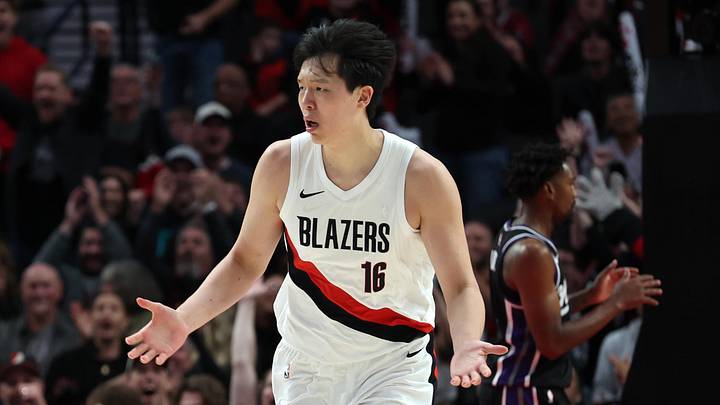
Nobody can definitively say yet whether or not the Portland Trail Blazers' Yang Hansen draft gamble will pan out. That said, Hansen's concerning lack of production in his rookie campaign raises questions about whether the Blazers front office's bold decision will backfire.
Despite Portland's expressed confidence in his ability to make an immediate impact, this season proved what most of the NBA world already believed -- Hansen remains a multi-year project. While it's far too early to say the No. 16 overall draft investment in a widely projected second-round pick is a bust, it does complicate the Blazers' offseason plans.
Blazers lack frontcourt clarity after Yang Hansen draft gamble
This season was eye-opening in that Donovan Clingan established himself as Portland's starting center going forward, justifying their decision to buy out Deandre Ayton and clear the path for the UConn product's breakout. However, that makes the Hansen selection all the more puzzling. Both centers are drop-coverage bigs, meaning neither can effectively guard the perimeter or play the power forward spot, and therefore play alongside each other.
Portland invested back-to-back first-round picks at center, yet still has uncertainty about depth at the position. They may not need the Clingan-Hansen positional redundancy resolved in the long term, but the unreliable depth complicates their offseason approach in the short term.
Most notably, retaining Robert Williams III must be considered a top priority for the Blazers this offseason. The talented but injury-prone big man is eligible for up to a four-year, $87 million extension, which can be signed by June 30.
Robert Williams III must be a top offseason priority
Portland has emphasized the center position with the remaining picks in its rebuild, yet the depth remains unresolved after the high-risk, high-reward gamble on Hansen. Williams may not solve the issue of adding another dimension as a big man who can play alongside Clingan, given his inconsistent ability to space the floor. That said, he does provide Portland with a new frontcourt dimension as a versatile defensive big who is far better equipped to guard out on the perimeter.
That's an increasingly valuable trait to have in today's NBA, and that versatility was on full display in Portland's first-round matchup against the San Antonio Spurs, where Williams even outplayed Clingan in the series due to being the better matchup.
Time Lord played 59 games this season, which was the second most of his entire career. Now that he's back to being his healthy and impactful self, the Blazers should essentially have no choice but to retain him this summer. Fortunately, they are in a strong enough financial position to keep both Williams and Matisse Thybulle around, though the former should be the clear top priority.
In a perfect world, the Blazers would be able to let Williams walk as they wouldn't deem it necessary to take on the injury risk. That has quickly shifted from a luxury to a necessity, specifically after seeing Hansen's inability to make an immediate contribution.
Portland doesn't want to throw its long-term project into the fire, and understandably so, as he still needs time to adjust to the speed of the NBA. But in the meantime, they must also balance what has become a win-now timeline under aging stars Damian Lillard and Jrue Holiday, and new owner Tom Dundon's expected win-now timeline.
Because it remains to be seen whether Hansen is even an NBA-level player, keeping Williams around is a no-brainer to help balance Portland's two-timeline approach. That's quite the offseason burden to take on for such an uncertain prospect in Hansen.
 Add us as a preferred source on Google