

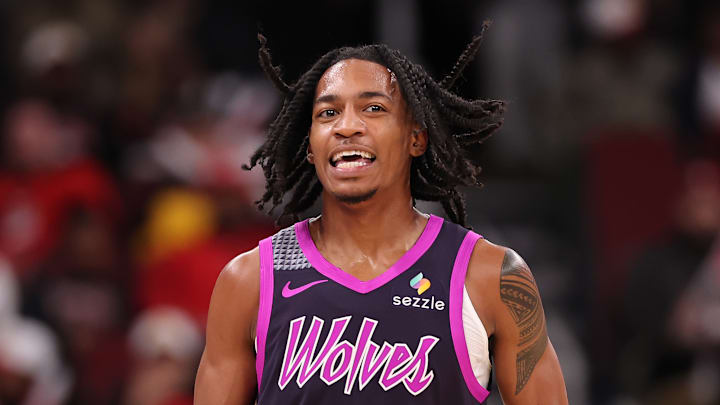
In the NBA Draft, betting on a guard coming out of Kentucky is rarely a bad idea. Just ask Devin Booker, Tyrese Maxey, Shai Gilgeous-Alexander, the list goes on. Unfortunately for the Minnesota Timberwolves, the one exception to this rule appears to be Rob Dillingham.
Following a promising season at Kentucky, the Timberwolves selected Dillingham with the No. 8 overall pick in the 2024 NBA Draft. They already seem to be regretting that draft decision.
It's incredibly early in his career, and too early to definitively declare a 21-year-old a bust, especially when guards take so long to develop in the NBA. But Minnesota has essentially already given up on that development.
Dillingham isn't a key part of the rotation, averaging just 10.2 minutes in 29 games played. In that limited stretch, he's averaging 3.8 points, 1.8 assists, and 1.2 rebounds, shooting an inefficient 35% from the field.
To make matters worse, the Timberwolves have already made the Kentucky product available for trade (subscription required), according to NBA insider Jake Fischer.
“I have heard, by the way, that parting with Dillingham is indeed on the table. The Wolves were certainly aggressive in acquiring the No. 8 overall pick in the 2024 NBA Draft to select Dillingham, but he simply hasn't been able to fill Minnesota’s playmaking needs as quickly as hoped and could well benefit from a change of scenery,” Fischer writes.
Blazers were right to pass on Rob Dillingham
Dillingham is incredibly undersized at 6-foot-2, 175 pounds. If Trae Young or Anfernee Simons are any indication, the market is trending away from these undersized, offensive-minded guards.
Perhaps Dillingham does get traded by the Feb. 5 deadline, benefit from the change of scenery, and go on to have a long, productive career. But given the top-ten draft investment, there are too many question marks surrounding his career trajectory.
Meanwhile, the Blazers, picking No. 7 in 2024, landed the safest prospect in the entire draft class: Donovan Clingan.
If the league is now prioritizing size and defense, then Portland was ahead of the curve, taking a 7-foot-2, 280-pound center. Everything Clingan did at UConn to lead his team to back-to-back NCAA national championships has translated to the next level in terms of his elite rebounding and rim protection.
Even better, he's proving that his ceiling is higher than many expected, and the improved floor spacing ability is a huge reason why. There were questions about how Clingan's interior dominance and back-to-the-basket game would fit in the modern NBA, but he's already addressing those concerns by connecting on an encouraging 33.7% of his three-point attempts this season.
Clingan is breaking out in his second year, averaging 11.2 points, 10.6 rebounds, 1.8 assists, and 1.3 blocks per game. He's benefited from Deandre Ayton's departure and has stepped up in this increased role as a starter.
The Blazers landed their center of the future in what was expected to be a weak draft class. And with Clingan and Dillingham already trending in opposite directions this early in their respective careers, Portland should be feeling even better about their decision.
 Add us as a preferred source on Google