

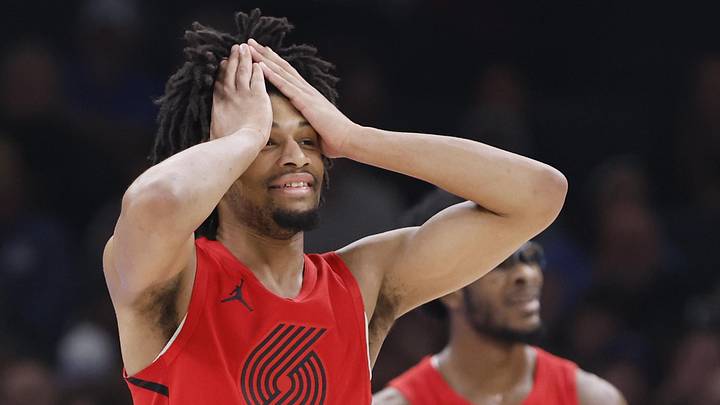
The Portland Trail Blazers committed to Shaedon Sharpe, inking him to a four-year, $90 million contract extension before the season. It was unclear whether they would take that route or risk Sharpe testing restricted free agency this upcoming offseason.
On the one hand, Sharpe has the highest upside on the team, warranting continued investment. He's just 22 years old and could elevate the entire ceiling of the Blazers rebuild if he reaches that star potential.
On the other hand, the case against an extension was that the idea of Sharpe as a player was more intriguing than the reality. His impact remained largely theoretical, as he has yet to put it all together.
Initially, Sharpe seemed to have justified Portland's extension. He was consistently named the standout performer in training camp and carried that over to the regular season, averaging a career-high 20.8 points per game.
However, as the season progressed, we unfortunately began to see the cons outweigh the pros behind that extension. A calf injury derailed Sharpe's momentum, and he never found his rhythm after returning to action with just two games left in the regular season.
Shaedon Sharpe shouldn't be considered a building block in Portland
That lack of impact carried over into the playoffs, where Sharpe appeared to be in Tiago Splitter's dog house. In that five-game stretch against the San Antonio Spurs, Sharpe averaged just 7.2 points in 13.4 minutes per game.
After the series, he made it clear that he was fully healthy, voicing his frustration surrounding the situation but opting not to share with the media what actually led to Splitter's decision.
Scoring has never been a problem for Sharpe, but it's just about every other facet of his game he needs to work on to become a more well-rounded player and make a genuine two-way impact in Portland. Lately, we've seen the market value for score-first, one-dimensional guards plummet around the league. The Blazers got ahead of that curve to a certain extent by trading Anfernee Simons last summer, but they still have another ongoing problem in Sharpe.
To make matters worse, Simons at least helped Portland's offense with his combo-guard skill set, providing them with much-needed playmaking and floor spacing. Sharpe operates more in isolation, which can come in handy to bail out a lackluster offense, but shouldn't be relied on as a sustainable solution.
The reality is that Sharpe's impact never justified a contract averaging $22.5 million annually. That's less than what Portland signed Toumani Camara to, and it's clear who has been more impactful the past few years.
Sharpe presented a greater dilemma for Portland, as they had to make a more educated guess about the player he would ultimately become. At the time, it appeared like the $90 million was a reasonable balance between what he's already shown and the upside he possesses. But the fewer signs of consistent progress Sharpe shows, the more concerning this decision becomes.
If he's not making a defensive impact and not helping Portland address its dire shooting problem, then I don't see anything beyond a sixth-man role in his future. Chauncey Billups benched him last season, and Portland was better off because of it. Splitter just came to that same realization in the playoffs, when it mattered the most.
At this point, it could be in Portland's best interest to cut ties with Sharpe, packaging him to land a more proven asset. He should still have trade value as teams could be intrigued by his tantalizing potential, so it's not necessarily a negative asset for Portland in that sense. But this is a disappointing development nonetheless, after how much they committed to Sharpe before the season.
It was a bet on him taking steps towards reaching that potential, and despite the fancy scoring totals, I don't think he's shown enough for Portland to feel comfortable in him as a key piece moving forward.
 Add us as a preferred source on Google