

The league is trending away from undersized, offensive-minded guards. Just look at the Trae Young trade, where the Atlanta Hawks didn't receive any draft capital when they sent the Washington Wizards a four-time All-Star.
Memphis Grizzlies star Ja Morant could be the next star moved by the Feb. 5 trade deadline, and while the situations differ due to contracts, Memphis will likely soon realize that the market for Morant isn't great either.
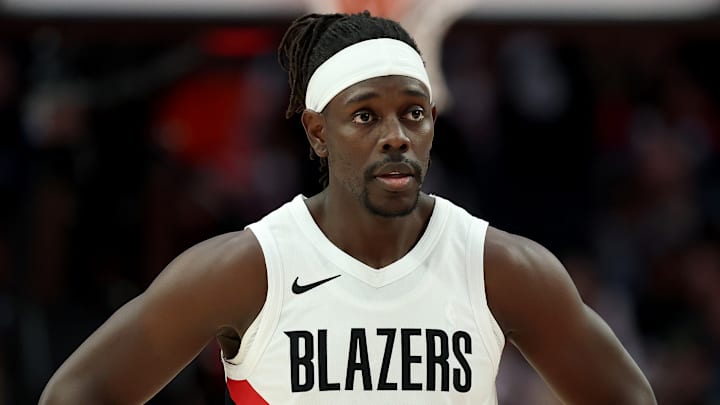
This recent market trend should make the Portland Trail Blazers feel much better about their decision to swap Anfernee Simons for Jrue Holiday with the Boston Celtics this past summer.
Jrue Holiday's two-way impact makes him more valuable than Anfernee Simons
Boston has explored trades for Simons, but they are even considering the possibility of keeping Simons past the deadline, as they may ultimately value him more than what he's worth on the market.
While Holiday may still be overpaid in the scheme of things, that contract suddenly looks much better when considering the Blazers have gotten ahead of the curve, pivoting towards a more impactful two-way guard.
While Holiday and Simons are averaging relatively similar points this season, this was far from a lateral move for the Blazers. Simons has consistently had one of the worst defensive ratings on Portland's roster over the last seven seasons. Holiday, meanwhile, has a total of six All-Defensive selections on his resume.
While he's no longer at the same elite level as a defender due to declining athleticism at age 35, it's still a stark difference between Simons and Holiday on that end of the court. Part of what makes Holiday a good defender is things that don't go away with age: positional versatility with a 6-foot-4 frame, quick hands, and a high basketball IQ that allows him to anticipate plays.
The defensive versatility is one of the most significant differences between him and Simons. So much of offense in the modern NBA is built around stars exploiting mismatches to initiate the offense. With Simons still around as Portland's weak link, it was hard for the Blazers to establish the defensive identity that general manager Joe Cronin has emphasized.
Now, we're seeing stars being picked up the length of the court by Toumani Camara, only to be switched onto Holiday, then run into the defensive anchor that is Donovan Clingan. It changes the equation entirely for Portland, making it much more difficult for opposing teams to game-plan against, as they have to find more creative avenues to gain an offensive advantage.
That was the obvious and most discussed aspect of this upgrade for Portland -- a team that took a significant defensive leap toward the end of last season was building off that momentum by upgrading its weakest link.
Jrue Holiday's scalability makes him a better fit for Portland
Still, one overlooked aspect of Holiday's game is his playmaking. He didn't necessarily have to showcase that in Boston with their star-studded roster and crowded frontcourt. The Blazers have had to rely on him much more as a primary ballhandler, and he's stepped up in that increased role.
Holiday and Simons are versatile combo guards, more than capable of playing both on and off ball. But Simons is proving that his ideal role on a contender is in a sixth-man capacity. He needs to join a winning situation and be put into a specific role to improve that situation. Meanwhile, Holiday is the type of player who can seamlessly fit anywhere.
Holiday proved to be the missing piece to get both Milwaukee and Boston a ring. He's also proving to be an essential part of a young Blazers core. That's the best thing about having Holiday in Portland. He's able to effectively scale his role to fit and add to an existing situation, whereas Simons needs teams to cater more towards him to provide value.
Both are great players, but that difference in scalability alone will go a long way toward Portland's path back to contention.
 Add us as a preferred source on Google