

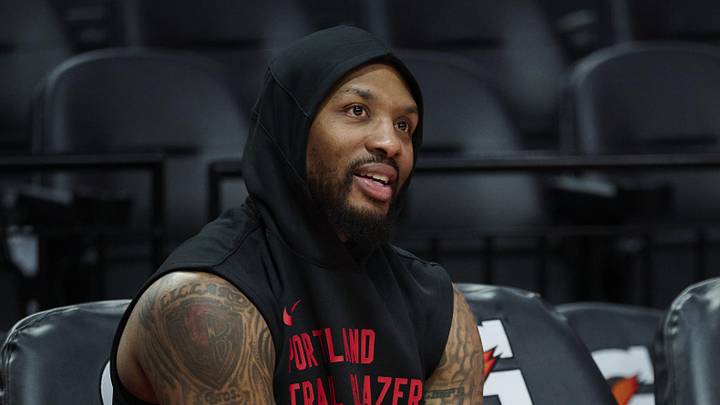
Considering he's already playing 5-on-5 pickup games, Damian Lillard is well on track to return for the start of the Portland Trail Blazers' 2026-27 season. His return comes at a perfect time for Portland, as this year's playoff appearance has proven that the young core is ready to take that next step to contribute to a deep playoff run. Better yet, their early first-round playoff exit to the San Antonio Spurs also showed that Lillard is a perfect on-court fit for what this roster needs.
"The Spurs series showed us that we don't shoot the ball well enough," Blazers general manager Joe Cronin said at his end-of-season exit interview. "Shooting is something we knew we were deficient in. Dame will definitely help us, but something we need to address going forward. We played a lot of possessions in the mud."
Blazers can't rely on Damian Lillard to solve all their problems
The Blazers have consistently ranked in the bottom five in three-point efficiency throughout their entire rebuild. Adding the three-time 3-Point Contest champion is about as good an addition you can make, at least in theory. But as Cronin mentioned, this is also something Portland needs to address externally this summer.
Relying on a 35-year-old Lillard returning from injury as the solution to your fatal flaw is not only unsustainable but also risky. Unfortunately, we don't know whether Lillard will return to form. In fact, history would bet against it.
There's some reason for optimism that Lillard could make a full recovery. His patient rehab approach certainly helps, sitting out the entire season despite rumors of a potential playoff return after the Blazers tied the Spurs series 1-1, stealing home-court advantage. Lillard addressed those rumors at his exit interview, saying that it wasn't realistic for anyone to expect him to be a playoff hero and that he never told anyone he had plans of a return.
That turned out to be a wise decision, as Portland continues to look ahead and certainly doesn't want to unnecessarily risk reinjury for such a key player. But what does "key player" mean in this context?
Lillard's uncertain return to form complicates Portland's offseason
That's the biggest question that will define Portland's 2026-27 season. Does that mean providing Deni Avdija with a much-needed co-star? Or does it mean embracing more of a sixth man role, bringing shooting, playmaking, and shot-creation to a second unit that desperately needs it?
Our best bet is that it's somewhere in between those two extremes. But if Lillard starts, what does that mean for the backcourt of Jrue Holiday and Scoot Henderson, which performed well in the playoffs? Do you trade Holiday, selling high on a bounce-back season before he gets older and even more expensive? Or, do you decrease Henderson's role yet again despite the promising flashes he showed towards the end of the season, particularly in the first half of that Spurs series?
These are pressing questions, as having the answers could make it much easier for them to navigate this pivotal offseason. Unfortunately, we won't know how Lillard returns until he, you know, actually returns. Even then, it could take until midseason for him to legitimately get his rhythm back.
Perhaps the best option for Portland is to take a wait-and-see approach, giving them more time to evaluate the roster before making such important decisions by February's deadline. But it does complicate their offseason plans, especially for a team that could even make a splash for a star under new owner Tom Dundon.
How aggressive do they want to be with a gradually developing core and uncertainty surrounding Lillard? There are many variables at play in this two-timeline approach, making Portland an interesting team to watch in the coming months.
 Add us as a preferred source on Google